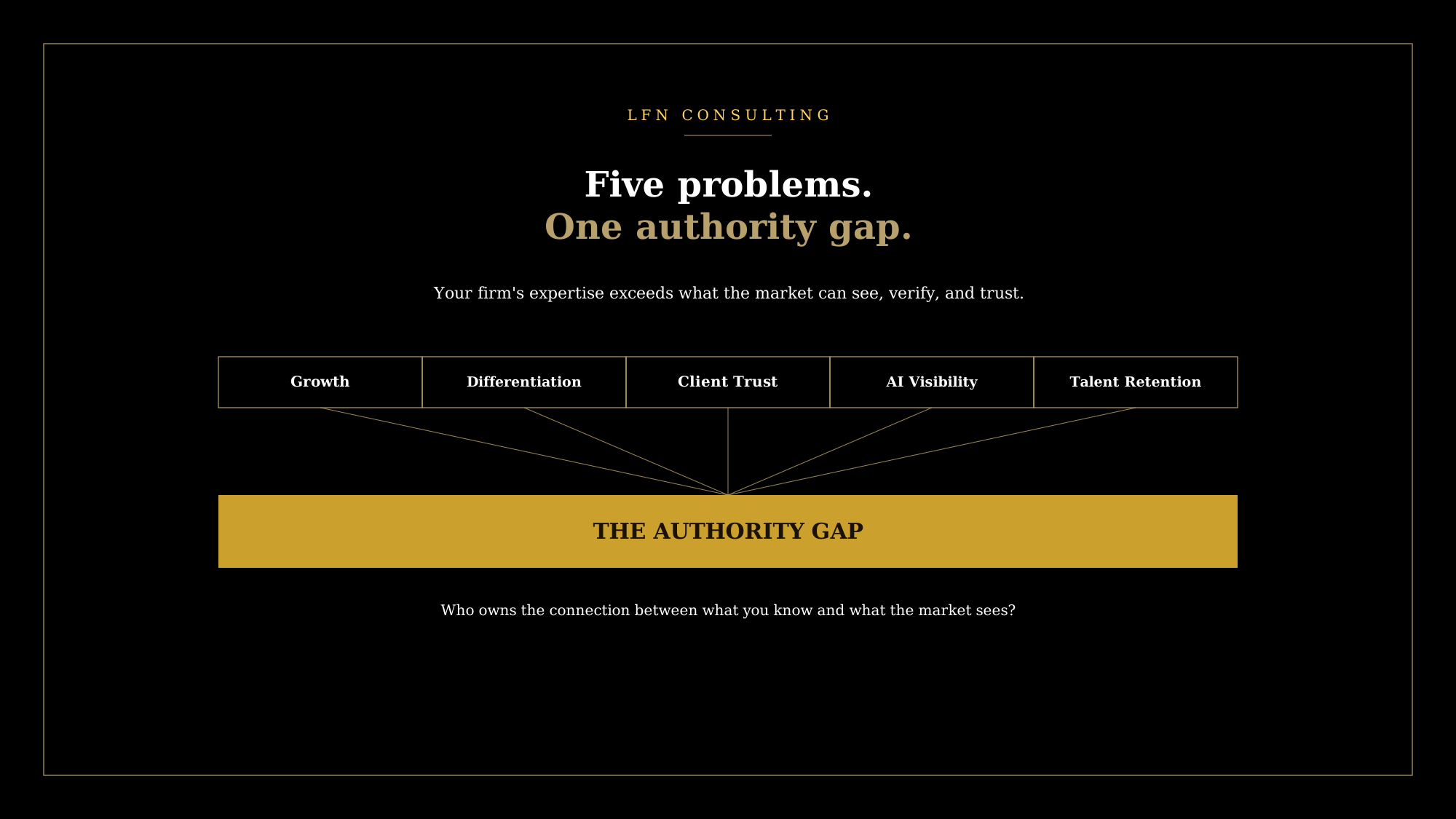
Professional services firms believe they are solving five different problems. Growth has slowed. Competitors with less experience are winning work that should have gone to them. Trust is taking longer to build. Their expertise isn't showing up in AI-generated answers. And talented people are leaving faster than they can be replaced.
Each one gets handed to a different part of the organization. Growth goes to business development. Differentiation goes to marketing. Retention goes to HR. AI visibility goes to the digital team, or to an outside consultant nobody else talks to. Each group builds its own plan, hires its own vendors, and measures progress on its own timeline.
I spent fourteen years inside a growing national accounting and advisory firm watching leadership teams confront different versions of this same pattern, year after year. The symptoms changed. The diagnosis rarely did. That experience shaped the perspective I bring to this work today.
The firm knew what it could deliver. Its clients often knew, too. But the broader market — and increasingly the AI systems shaping how buyers discover firms in the first place — didn't have enough visible evidence to understand, verify, and trust that expertise.
That's an authority gap. And you cannot close it by treating five symptoms as five separate problems.
1. Growth stalls even when the firm is doing everything right
When growth slows, the instinct is to add: another business development hire, an expanded practice group, more marketing spend. Sometimes that helps. But it can't fix a problem that started long before the sales conversation ever happened.
Buyers are researching firms and individual experts on their own now, comparing viewpoints, looking for evidence, asking people they trust who belongs on the shortlist — and increasingly asking AI platforms to help build that list. By the time a formal opportunity reaches business development, much of the decision has already been shaped.
The firm isn't always losing because its people can't sell. Often it's losing because too little authority was built before the selling ever began. Growth doesn't stall by accident; it stalls when effort fails to compound into visible trust.
2. Competitors who aren't better are still winning
Most established firms have capable people. Plenty can deliver comparable technical work. The gap usually isn't capability — it's how easily a buyer can recognize and verify that capability from the outside.
One firm has visible experts with clear points of view. Its leaders get quoted, published, invited to speak, and consistently associated with the issues clients actually care about. The competing firm may have equal or deeper expertise, but almost none of it is visible beyond the walls of the organization.
That's a hard truth for leadership teams to sit with: the best firm doesn't automatically win. The firm that appears most credible before the first conversation often walks in with an advantage that technical strength alone can't overcome.
3. Client trust is being decided earlier than firms realize
Professional services buying decisions rarely belong to one person. There's an executive sponsor, a CFO assessing risk, a board member asking questions, an internal team comparing options, outside advisers weighing in — and most of them are doing their own research before your firm is ever in the room.
They want to know whether you understand organizations like theirs, whether your leaders have addressed this exact issue before, and whether they can find evidence of that beyond your own website. When those answers are hard to find, trust takes longer to build — and sometimes the firm never even learns it was in the running. The decision starts quietly, long before the pitch.
Trust leaves evidence, and the firms pulling ahead are building it as deliberately as they build any other function that drives revenue.
4. AI can't recommend expertise it can't see
A strong website still matters. It's no longer enough on its own. Buyers are using ChatGPT, Claude, Perplexity, Gemini, and other tools to research problems, compare approaches, and identify potential advisers. These platforms don't experience a firm through one homepage or one campaign. They encounter a body of evidence — articles, bylines, media coverage, speaking appearances, consistent executive commentary, industry recognition, third-party references, and clear, repeated connections between an expert, a firm, and a specific area of expertise.
When that evidence is thin or scattered, AI systems have less reason to associate the firm with the question being asked. That doesn't mean AI visibility should become one more isolated initiative handed off to an SEO vendor. It's an outcome, not a project. A firm doesn't become trusted because it ran an AI audit — it becomes easier for AI to recognize because its expertise has been made visible, structured, and verifiable over time.
5. Top talent can't see the firm the market is being promised
Retention gets treated as a comp, benefits, or recruiting problem. Those matter. But people also leave when what they experience inside the firm stops matching the story being told outside it.
They hear the firm values innovation but don't see its experts actually supported. They hear it develops leaders while the same small group gets every visible opportunity. They hear "collaborative culture" while practice groups quietly protect their own relationships. They watch talented colleagues do excellent work that nobody outside their group ever hears about.
Over time that stops being a communications problem and becomes a trust problem. People advocate for a firm when they can see themselves in its future. They refer work across practices when they understand and believe in the people doing it. They stay when recognition and opportunity show up in everyday decisions, not just in the recruiting deck. Trust leaves evidence internally, too — not just with clients. The brands that earn belief rarely do it through messaging alone; the people closest to the experience help determine whether the story is believed.
The authority gap underneath all five
Slowing growth becomes a sales problem. Weak differentiation becomes a marketing problem. Slow-building trust becomes a BD problem. AI invisibility becomes a technology problem. Talent attrition becomes an HR problem. Each one gets misdiagnosed the same way.
Underneath all five is the same gap: a disconnect between what the firm can actually deliver and what its buyers, employees, referral sources, and the broader market can see, verify, and believe. It shows up when a firm's best expertise stays trapped inside client work. When leaders are highly capable but largely invisible. When marketing, BD, culture, and executive visibility all operate as separate departments instead of one system. When a firm's reputation rides on a handful of well-connected individuals instead of an intentional infrastructure.
Growth doesn't stall by accident. It stalls when trust stops compounding across the organization.
What closing the gap actually looks like
Authority isn't built by publishing more content or getting one executive into the trade press. It's built as a connected system, starting with an honest read of how the market currently perceives the firm and a clear point of view about what it should be known for — then identifying the leaders capable of carrying that authority and the evidence needed to support it. Firms and leadership teams typically start with the Authority Snapshot™, a diagnostic that shows where their authority infrastructure is broken and what to build first.
From there, thought leadership, earned media, executive visibility, digital presence, and internal culture stop operating as separate workstreams and start reinforcing each other. A sharper point of view earns better speaking and media opportunities. Third-party visibility strengthens how both search engines and AI systems recognize the firm. External recognition builds internal confidence, which produces more referrals and stronger internal ambassadors — and by the time business development gets involved, trust is already forming instead of starting from zero.
That's what infrastructure does. It builds a system where individual efforts compound instead of disappearing the moment a campaign ends or a visible leader walks out the door.
What eighteen months of authority building can produce
I saw this play out at the firm level while helping build LBMC's brand and market visibility during a stretch when the organization grew from roughly $52 million to $241 million in revenue and expanded from three markets to eight. The experience behind Authority Infrastructure™ was built from inside those kinds of growth decisions, acquisitions, executive transitions, and organizational challenges.
I've also seen it play out for one rising leader specifically. She'd been brought in to lead a newly launched service line. The technical ability was there, but referrals were inconsistent, the market didn't know her name, and competing firms were actively circling her.
We didn't start with a lead-generation campaign. We started by defining a distinct point of view, rebuilding her LinkedIn presence, developing thought leadership, pursuing targeted recognition and earned media, and creating opportunities for colleagues across the firm to actually understand and advocate for her work. It unfolded over eighteen months — the early months built the foundation, the middle created visible momentum, and by the final stretch, cross-firm referrals were accelerating and outside prospects were finding her through AI-assisted research.
By month eighteen, her practice had grown 400% and she was turning down speaking invitations because the team was already too busy hiring to keep up with demand.
That didn't come from one article, one award, or one platform. It came from five connected pillars working together, until her expertise became genuinely difficult to overlook — inside the firm, in the market, and across AI discovery.
One diagnosis, not five vendors
Professional services firms don't have five unrelated problems. They have one organizational challenge showing up in five different places.
Leaders can keep buying separate fixes for every symptom — another BD hire, another brand refresh, another retention program, another AI audit, another short-term visibility push. Or they can build the infrastructure that connects all of them, because buyers can't choose expertise they can't see, employees can't advocate for a story they don't live, and AI can't recommend authority that has never left a visible trace.
The firms that win the next decade won't simply be the ones with the strongest capabilities. They'll be the ones that make those capabilities visible, credible, and trusted before the first conversation ever happens.
That's Authority Infrastructure™.
Take the Authority Assessment to see where your firm's authority is strong, where it's fragmented, and where the gaps may be limiting growth.





.jpg)