Long before I knew the phrase "product placement," I was learning about visibility at our dinner table.
My father, Paul B. Flynn, helped launch USA TODAY in 1982 and later served as its President. At our house, the paper was part of every conversation.
He talked about building a national newspaper around the way people were already reading. Readers were busier, and many were getting their news in different places. So the paper met them with shorter stories, color, and graphics people could understand at a glance.
The idea he came back to most was simple.
Pay attention to where people are getting their information, then go meet them there.
A newspaper box on a movie set
That idea eventually took USA TODAY to Hollywood.
The team worked with filmmakers before release, supplying its distinctive newspaper boxes and creating custom prop editions written for each storyline. If you watched Ghostbusters, Back to the Future Part II, Total Recall or Minority Report, you saw some version of it.
My favorite example is Runaway Bride.
In the original script, Richard Gere's character was a reporter for The New York Times. USA TODAY opened its offices to the production, and by the time the film was made, he was a USA TODAY reporter.
According to Norm Marshall, who managed the paper's film placements for decades, USA TODAY never paid for a role. The brand earned those appearances by being useful to filmmakers and relevant to the story.
I think about that example often.
A competitor was already written into the script, and USA TODAY won the part by being the most helpful partner in the room.
This summer, the brand did it again.
USA TODAY PLAY partnered with Marvel Entertainment on Spider-Man TODAY, a weekly comic formatted for people reading on their phones.
Forty-four years separate a newspaper box and a phone screen.
The discipline behind them is the same one my father talked about over dinner.
What I saw inside LBMC
That lesson followed me into my own career.
In 14 years leading brand at LBMC, a big part of my job was turning the expertise inside the firm into visible market authority, the firm grew from $52 million for 241 million in revenue.
I saw the difference when our experts showed up consistently in the press, in search, in thought leadership and through clients willing to vouch for them.
Buyers who had already read our people, heard their names or seen them quoted often entered the first conversation further along.
That experience is one reason I launched LFN Consulting this summer.
And within the first weeks, I am seeing the same need across accounting, law, wealth management, healthcare and other professional services organizations. Artists and music industry executives too.
Strong leaders. Strong expertise. Strong talent. Too little visibility where buyers are already looking.
My work now focuses on closing that gap, helping leaders and organizations make their expertise visible where buyer attention already lives, across earned media, search, executive visibility, thought leadership and increasingly, AI.
Buyer attention is moving again
Today, buyers often form an opinion about your organization before they ever call.
The process might start with an article, an executive's LinkedIn post, a client review or a referral followed by quiet research.
Increasingly, that research includes asking ChatGPT, Claude or Perplexity who to consider.
Those tools draw from the public information available about your organization and its people.
If your leaders have little visible proof around their expertise, buyers and AI have less information from which to understand why your organization belongs in the conversation.
Every one of those moments feeds the same private question:
Do I trust these people enough to take the next step?
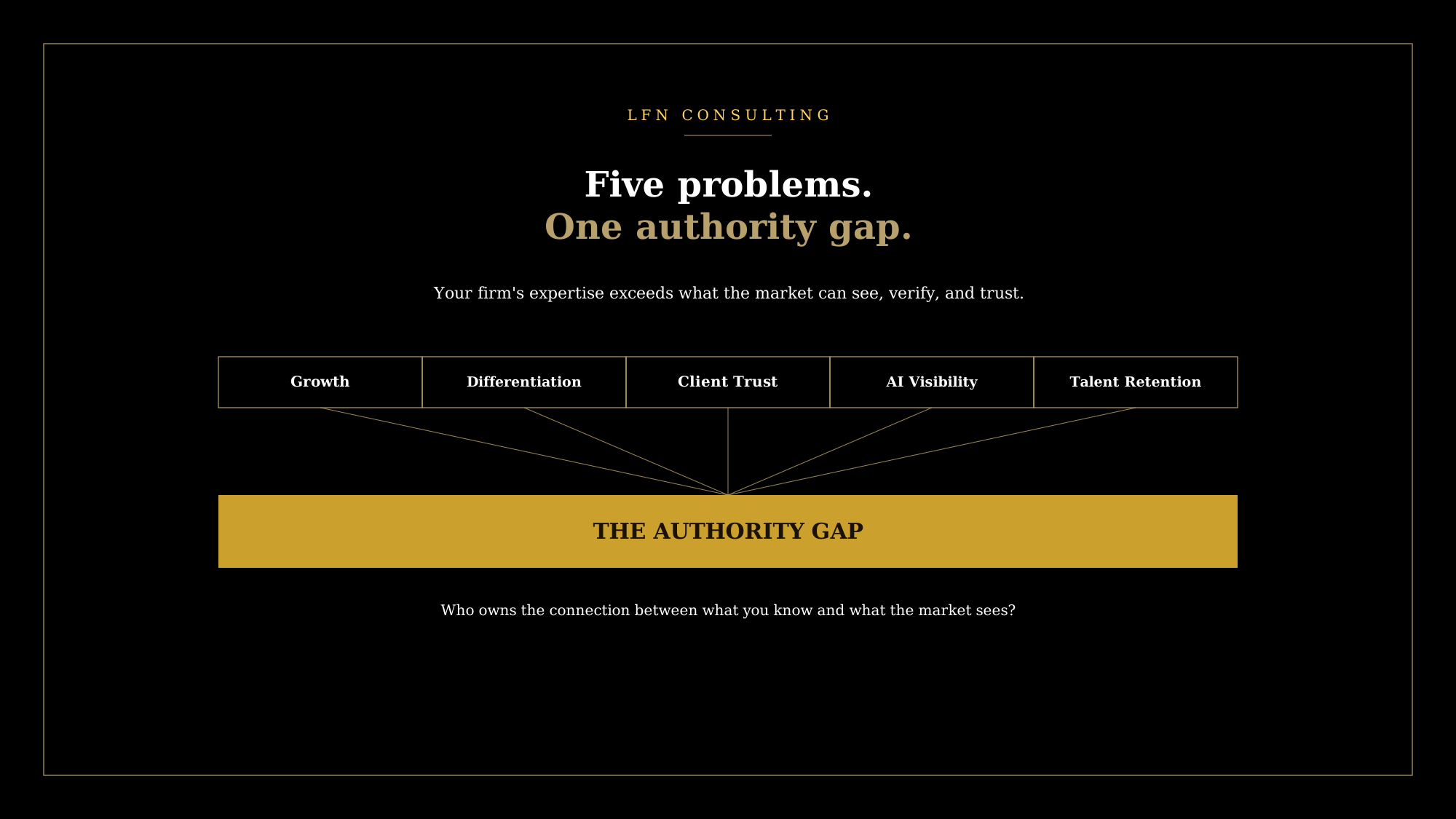
The authority gap
I see the same pattern across the leaders and organizations I work with.
The talent is strong.
The expertise is strong.
What is missing is visibility where buyers are already looking, including AI.
Part of the problem is structural.
In many professional services organizations, PR, search, growth, executive visibility, thought leadership and AI visibility sit with different teams. Each gets treated as a separate initiative.
Buyers experience one company.
When ownership is scattered, the proof they find is scattered too.
That gap is an authority problem.
And it costs organizations opportunities they never see because a buyer forms an opinion before the phone ever rings.
A few questions are worth asking your leadership team:
- Where are buyers forming opinions about us before they speak with sales?
- What credible proof do they find when they look?
- Does our expertise show up consistently across media, search, LinkedIn, reviews and AI?
- Who owns the full picture?
My father's generation figured this out with a newspaper box on a movie set.
When behavior changes, follow your audience.
Then give people credible proof before they need to ask for it.
The Trust Check: Is your expertise stronger than your visibility? If so, you have an authority gap.